
Hip Replacement
A Clinical Alternative to Standard Total Hip Replacements
A More Versatile Hip Replacement
I led background research and material selection for a proposed artificial hip prosthesis, focusing on how biomaterials influence long-term safety, durability, and patient outcomes. My work evaluated metals, polymers, and ceramics through biocompatibility, corrosion resistance, wear behavior, and mechanical performance inside the body.
I guided the proposed design toward titanium-based alloys for structural components due to their favorable biocompatibility and affordability, while investigating polymer liners (e.g., PEEK) and surface treatments to mitigate wear and friction. This included assessing risks such as metal ion release, implant-associated infection, and particle-induced inflammation.
I also incorporated ethical and accessibility considerations into material selection, balancing material sourcing impacts with the need for affordable implants.
The Solution
The team’s proposed hip prosthesis follows standard total hip arthroplasty geometry while optimizing materials for biocompatibility, durability, and accessibility. We selected titanium–copper alloys for structural components to balance strength, corrosion resistance, and cost, and proposed a PEEK liner over UHMWPE for improved wear performance and biocompatibility. The femoral stem was designed with a hydroxyapatite surface treatment to promote osseointegration. This proposed design prioritizes long-term performance while keeping the implant affordable and clinically practical.
Materials:
Acetabular component: Titanium–copper alloy
Polymer liner: PEEK
Femoral head: Titanium–copper alloy
Femoral stem: Titanium–copper alloy with hydroxyapatite surface treatment
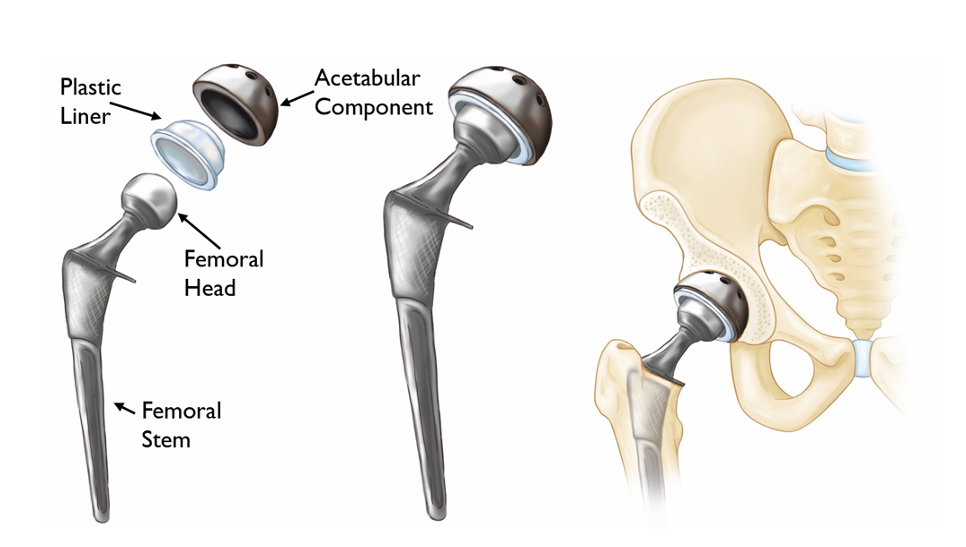
Standard total hip replacement geometry (acetabular cup, liner, femoral head, and stem) matching our proposed design. Image source: Total Hip Replacement, American Academy of Orthopaedic Surgeons (OrthoInfo).