
LuminEye
Wearable Insomnia Treatment
An Easier Way to Fall Asleep
Insomnia affects roughly 15–20% of the population and disproportionately impacts students, where chronic stress, irregular schedules, and late-night screen use compound sleep disruption. Beyond fatigue, insomnia erodes productivity and performance across academic, social, and professional domains, ultimately reducing overall quality of life. My role on LuminEye focused on background research, needs identification, and market analysis to ensure the problem was framed around real user symptomatic pain points rather than just a technical solution.
The Challenge
Through literature review and user discovery, I helped ground the project in circadian biology. Light-sensitive retinal cells signal the suprachiasmatic nucleus (SCN), which regulates melatonin release from the pineal gland - suppressing it in daylight and stimulating it in darkness.
Research by Lisa A. Ostrin and others shows that artificial light exposure at night disrupts this natural rhythm, while bright daytime light and dim evening light support healthy sleep cycles. This insight reframed insomnia as more than just a behavioral problem; it reflects a physiological mismatch between modern light environments and human biology.
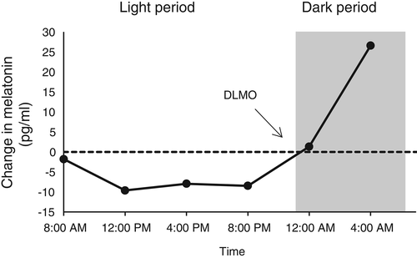
The brain regulates melatonin levels based on the wavelength of light entering the eye. Image source: Lisa A. Ostrin.
The Solution
LuminEye emerged as a concept for a wearable insomnia aid that modulates the light entering the eye - filtering blue wavelengths and introducing low-intensity red light in the evening; to support natural melatonin production.
My contribution centered on validating this approach through researching competitors. Most existing light-therapy wearables rely on fixed-color illumination or interchangeable lenses with narrow brightness ranges, primarily using blue or blue-green light to shift circadian rhythms. LuminEye differentiates by integrating multi-color LEDs with a wider, tunable luminosity range and prioritizing red light to support melatonin production, positioning it as a sleep-promoting solution rather than a wakefulness tool.
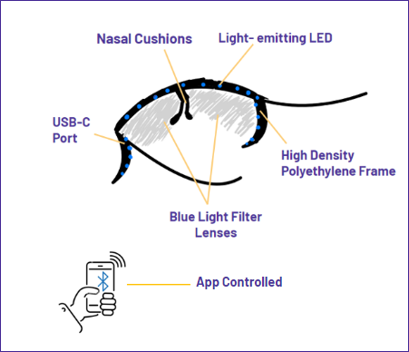
Visualization of our proposed product.