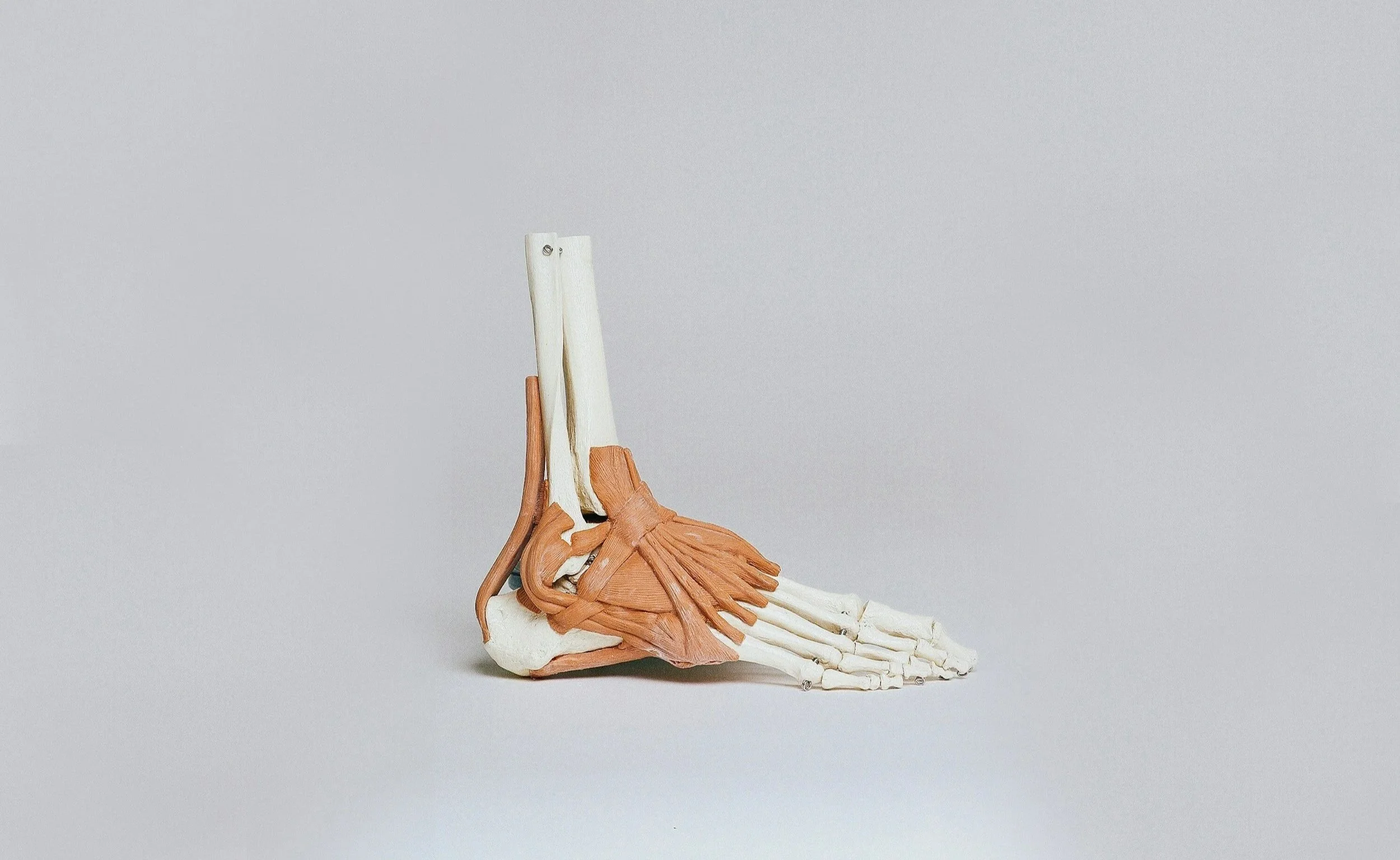
Custom Orthotic
Non-Newtonian Fluid Based Shoe Orthotic
Support That Moves With You
High arches concentrate pressure on the heel and forefoot. Traditional orthotics, built around static, semi-rigid layers, struggle to adapt as loads shift during running or prolonged standing.
After more than a decade of wearing prescription inserts, I found that fixed stiffness and foam compression often created new pressure hotspots and restricted natural foot motion over time.
To address this, I developed a dynamic multilayer orthotic with a contoured structural base, a sealed shear-thickening fluid core, and a cushioned top layer; the fluid migrates under low loads to conform to plantar contours and evens out pressure, then stiffens under impact to absorb shock while maintaining stability.
Highlights:
Adaptive Pressure Redistribution
Comfortable Design
Timeline: April 2025 - May 2025
The Design
To address the rigidity of traditional orthotics, I focused on what worked in my own inserts: the layered construction, and replaced what didn’t: static stiffness. I needed a passive way to dissipate force while remaining adaptive, which led me to shear-thickening, non-Newtonian fluids. Early prototypes using an Oobleck-soaked sponge improved pressure distribution but introduced leakage and instability, pushing me to pursue a more controlled fluid system.
I refined the design by custom-ordering a thin silicone bladder filled with a silica PEG suspension, shaping the fluid core to be wider and thinner to distribute pressure without sloshing. The final insert integrates a contoured semi-rigid base for structural support, a sealed fluid core that flows under low loads and stiffens under impact, and a cushioned top layer for comfort and smooth pressure transfer. Since the arch is supported by a tendon that stretches during prolonged standing, flattening the foot over time, this adaptive system maintains support in real time, something static orthotics can’t do.
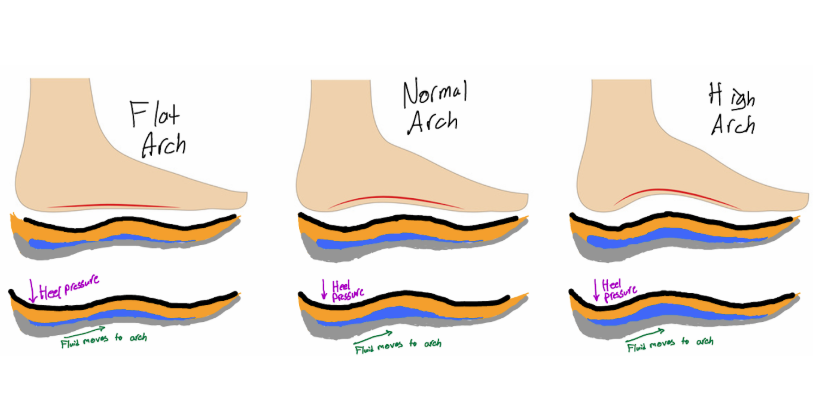
Early sketch of my design. The fluid is shown in blue, and is relocated in response to the position and pressure applied by the foot, ensuring uniform stabilization.
The Solution
The redesigned orthotic adapted to load instead of forcing the foot into a rigid shape. During running, heel strikes were softened without sacrificing stability, and during uphill walking the fluid shifted to support the heel and arch, creating a supported feel without confinement. While standing for a prolonged while, the fluid redistributed to maintain even pressure across the arch and heel, preventing the familiar discomfort of localized pressure buildup.
Because my pain was localized to the arch, the bladder was limited to that region with a slight extension into the medial heel; after two weeks of daily wear, visible wear appeared at the heel and toe while the fluid-supported region showed minimal degradation, validating pressure redistribution. Overall, the prototype delivered smoother impact handling, improved comfort, and reliable corrective support. Future iterations should extend the bladder throughout the orthotic to improve durability and distribute wear.
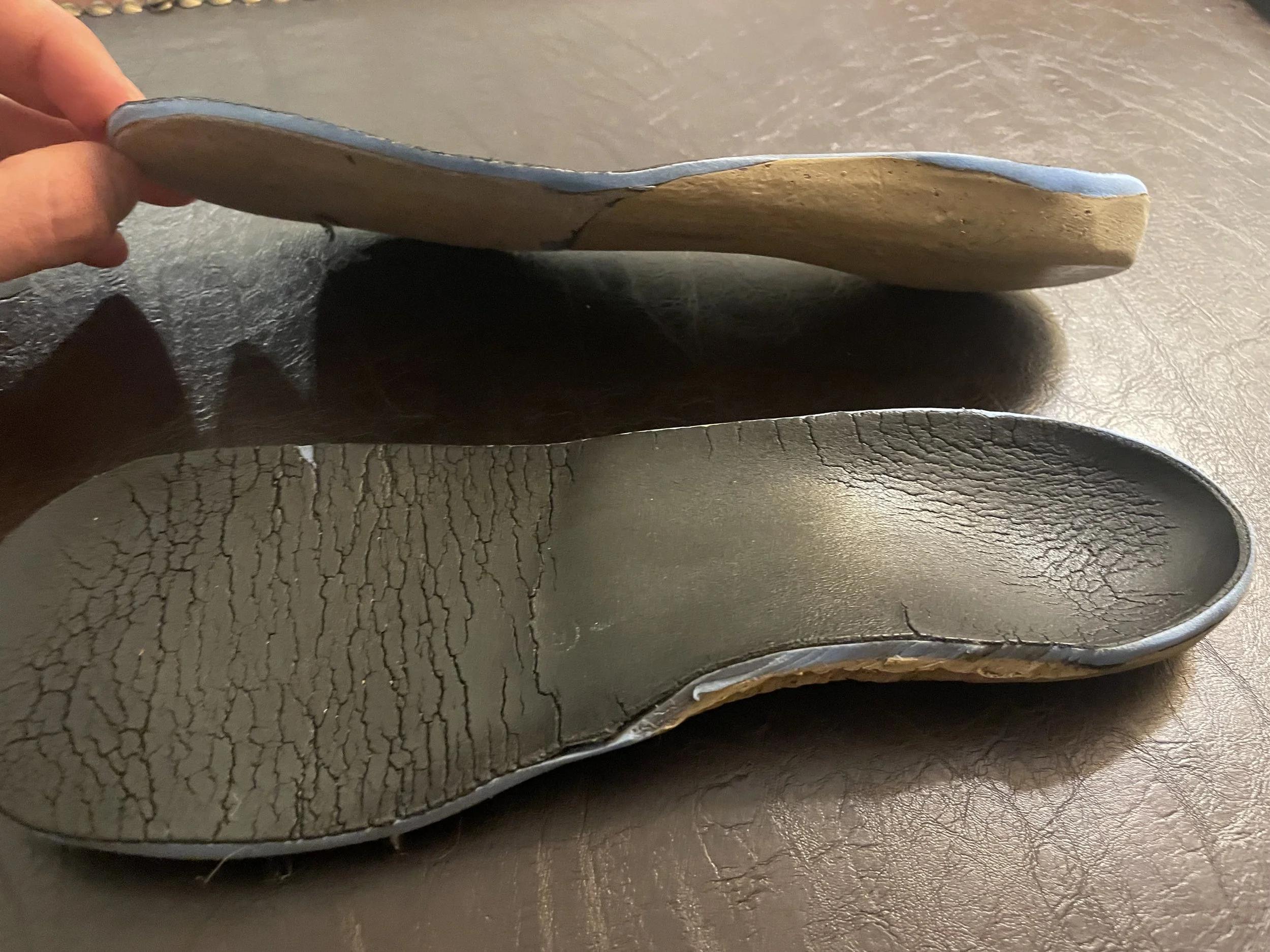
Final design. This was worn for 2 weeks. Note the wear on the orthotic is only in the areas lacking the bladder, confirming that force is being redistributed along the arch.